• Overview
  • Personal Work
  • Commissions
  • Portfolios
    • Portrait
    • Travel
    • Food
    • Spaces
  • Info
  • Journal
  • Menu

Andrew Faulk

Tokyo-based editorial and commercial photographer creating human-centered imagery rooted in people, culture, and place.
  • Overview
  • Personal Work
  • Commissions
  • Portfolios
    • Portrait
    • Travel
    • Food
    • Spaces
  • Info
  • Journal
camels-salt-farmer-afar.jpg

Salt Farming In Afar, Ethiopia

August 29, 2020 in Documentary

Much of my life before moving to Tokyo was spent in the rural areas of the American South. Though not the son of a farmer, I grew up next to fields of tobacco, corn, and grazing cattle. As a child, I loved watching hay bails being loaded onto flatbed trucks donning “farm use only” license tags, and seeing overall-clad farmers walking their fertile land. I saw farmers and their farmhands walk into the fields as the sun rose and shut off the barn lights well after dark.

At the time, I didn’t realize that these scenes served as my introduction to the concept of industry. While I wasn’t yet aware of stock futures or agricultural regulation, the scenes helped me comprehend the incalculable amount of sweat it takes to carve out a life as a farmer.

Five years ago I photographed a salt farm in Sinan County, South Korea for a short series titled Southern Salt. This was my first time seeing salt cultivation. I was intrigued by the massive salt flats made thick black tarps and levees to separate the individual salination pools. The sun beat down and the farmers worked furiously to cultivate and collect the salt. Watching the Korean salt farmers took me back to my childhood and reminded me of the American laborers who, as I know now, worked so damn hard for so little.

Early this year, I had another chance encounter with salt farming. Far into the Danakil region of northern Ethiopia, I witnessed a way of farming salt that was much older and laborious than the one I witnessed in South Korea.
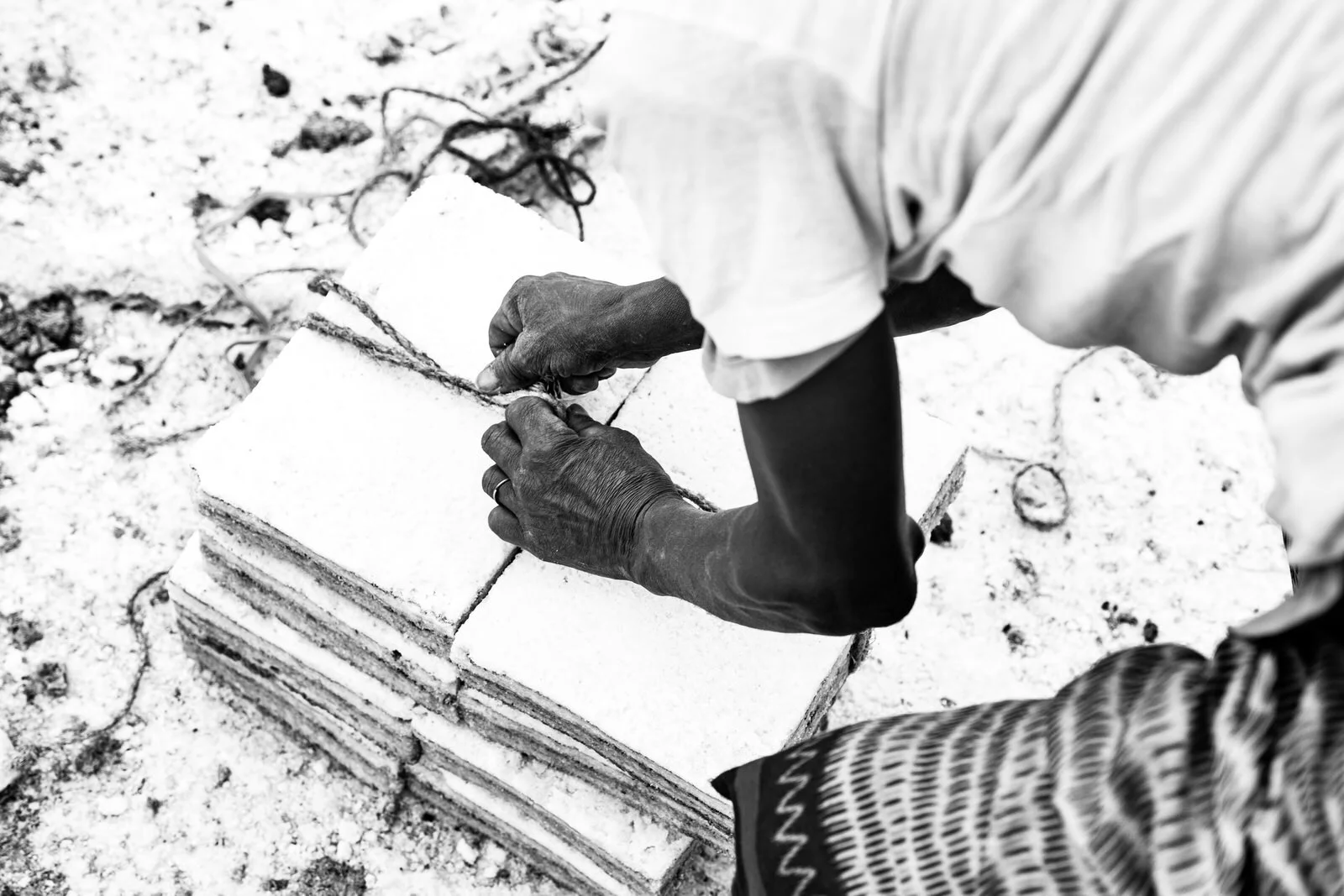
Ethiopian salt farmer binds a stack of ten salt slabs.

Ethiopian salt farmer binds a stack of ten salt slabs.

These Ethiopian salt “mines” form part of the Danakil Depression, a 60,000 square meter mineral deposit that reaches up to 100 meters below sea level. It is here in the Danakil that the Afar tribe has mined the salt that was left as an unexpected gift by ancient Red Sea floods. For centuries, this stretch of baked earth gave a trade to the Afar people and established the Ethiopian salt industry.
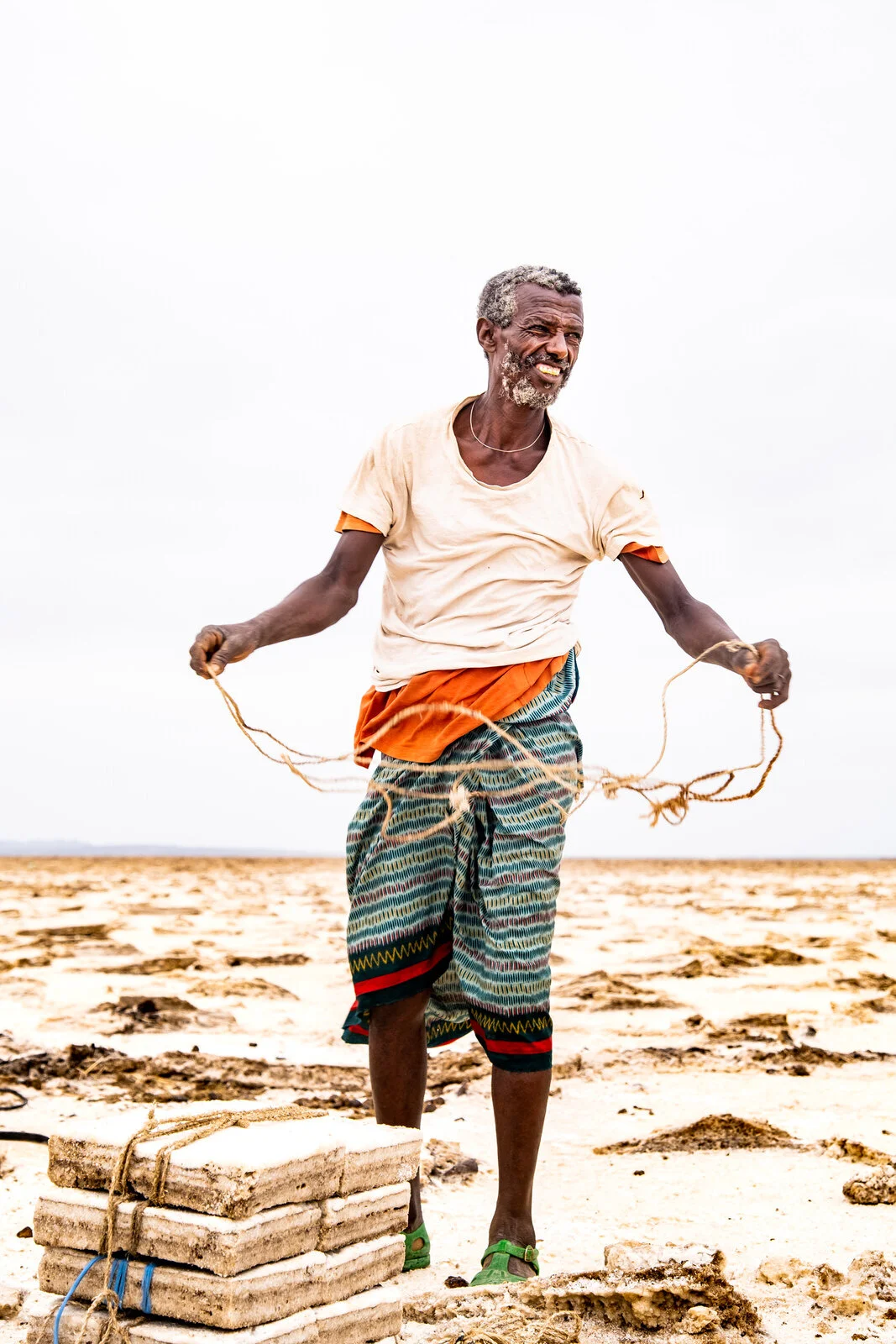
Salt farmer binds a stack of salt.

Salt farmer binds a stack of salt.

Carved salt bricks.

Carved salt bricks.

To say that salt extraction in the Danakil is laborious would be an understatement. Each plate of salt is extracted from the earth’s crust, hand-chopped into massive slabs, and then reduced to manageable tiles. To transport the salt, thousands of donkeys and dromedaries (also called Somali or Arabian camels) are loaded to the hilt and form caravan lines that will trudge to Berahile, a make-shift commercial town three days walk away. Once in Berahile, eager merchants gather from across Ethiopia to buy and sell the mineral that both Ethiopian homemakers and farmers rely upon.

Camel caravan returning back to the salt plains of the Danakil to fetch another load of salt bricks.

Camel caravan returning back to the salt plains of the Danakil to fetch another load of salt bricks.

This physical strain of salt production is compounded by the environment. The Afar salt farmers conduct business in an inhospitable landscape. Appropriately nicknamed the “Gateway to Hell,” the Danakil is one of the hottest places on Earth. With daily temperatures averaging 34˚C (and frequently touch 50˚C), the salt farmers of the Danakil work in an unimaginable cauldron in order to survive and to carry on the traditions that have sustained the Afar people for generations. From the first chop to sale, the process of salt mining in the Danakil is truly one of the most physically demanding ways any farmer could make a living.

Beginning of the vast expanse of salt deposits in the Danakil Depression of northern Ethiopia.

Beginning of the vast expanse of salt deposits in the Danakil Depression of northern Ethiopia.

Leaving the region, I learned that Danakil salt was once so valuable that people used it to barter, an unofficial currency. I sat in silence hearing that now, with corporate competition and Ethiopian modernization on the rise, each hand-carved slab will only yield four Ethiopian birr (twenty cents per four-kilo brick). After spending a short amount of time learning about the process of salt farming in Ethiopia’s far north, I was taken back to the farms of East Tennessee and was again reminded about the effort and energy it takes to sustain an industry. I was reminded of the people who, despite making the industry prosper, never truly reap the rewards of their efforts. Here in Ethiopia, we find yet another example of how, for some, hard work doesn’t pay off.


More From Andrew Faulk

Lalibela Pilgrims

Lalibela Pilgrims

Travel Photography Portfolio

Travel Photography Portfolio

Spaces

Spaces

Tags: Ethiopia, Afar
Comment
Machiya-Shinsen-en-Kyoto.jpg

Machiya Shinsen-en | Japan Hotel Photographer

August 18, 2020 in Hospitality, Commercial Photography

Staying in a Japanese machiya is like stepping out of the fast-paced world and immersing oneself in a slower, contemplative rhythm. It's a peaceful and serene experience that connects you to ancient traditions. Entering a machiya, the bustling noise of the streets fades away, and the tranquility of wooden beams, tatami mats, and shoji screens seeps in. As a hotel photographer in Japan, I was thrilled to receive a commission to travel south from Tokyo to photograph a modern take on traditional machiya.

In the mystical city of Kyoto, where ancient temples hold untold stories and cherry blossoms gracefully dance in spring, a new hotel emerges. The Machiya Shinsen-en, located just a five-minute walk from the majestic Nijo Castle, weaves a tale of tradition and innovation in its 21 rooms. The hotel takes its name from Shinsenen, a renowned Buddhist temple nearby, and combines the charm of a traditional Japanese townhouse with the spiritual ambiance of the temple, offering guests a unique and culturally rich experience.

Once a reflection of Kyoto's architectural heritage, this old-world townhouse has been meticulously renovated to blend the traditional with the contemporary. Each room in the hotel tells its own story, capturing the essence of a bygone era while providing modern comforts.

Detail rich, the Machiya Shinsen-en seamlessly integrates traditional and contemporary elements throughout. Upon entering the hotel, guests are welcomed into a tranquil lounge on the first floor, bathed in natural light. The open space invites patrons to enjoy an exquisite breakfast if they wish. The suite rooms, each with its own allure, cater to discerning travelers. More, the spacious corner suites exude luxury, while the more traditional accommodations pay homage to the grandeur of classic Kyoto townhouses. Every suite room is equipped with a kitchen, washer/dryer, and various convenient amenities for those seeking an extended stay. Families and larger groups can also find comfort within the hotel, as it fosters unity and togetherness.

Throughout my decade of traveling and photographing Japan, I have visited countless guest quarters, each with their own character and charm. Without doubt, I know that I will return as a guest of the Machiya Shinsen-en, an enchanting abode that breathes life into Kyoto's rich heritage and stands as a testament to the beauty of blending tradition and innovation in perfect harmony.

Scroll down to see some of my favorite images created for The Machiya Shinsen-en in Kyoto, Japan.

shinsen-en-tea-set.jpg
machiya-curtain-detail.jpg
wall-color-abstract-1.jpg
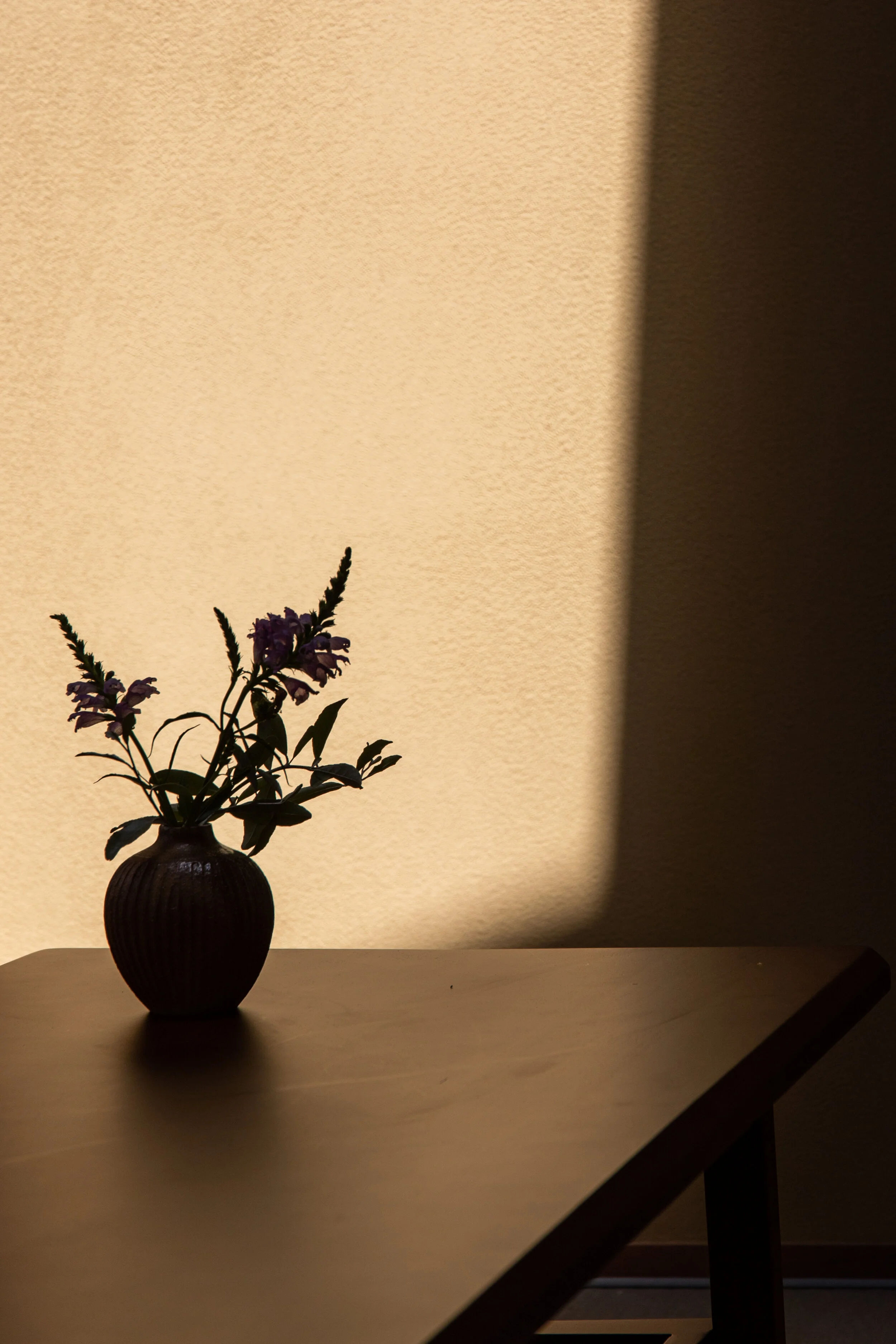
machiya-flowers.jpg
machiya-shinsenen-skylight.jpg
wooden-staircase-kyoto-hotel.jpg
Machiya-Shinsen-En-.jpg
eph-hotels-coffee
machiya-shinse-en-bed.jpg
flower-silhouette.jpg
machiya-shinsenen-bathtub.jpg
abstract-hotel-bathroom.jpg
machiya-lightbeam.jpg
window-wood-treatment-1.jpg
hotel-hanger-minimal-1.jpg

Related Content

Spaces | Photography Portfolio

Gawa | Commercial Portrait Photographer

Tags: Japan, Hotel, Architecture
Comment
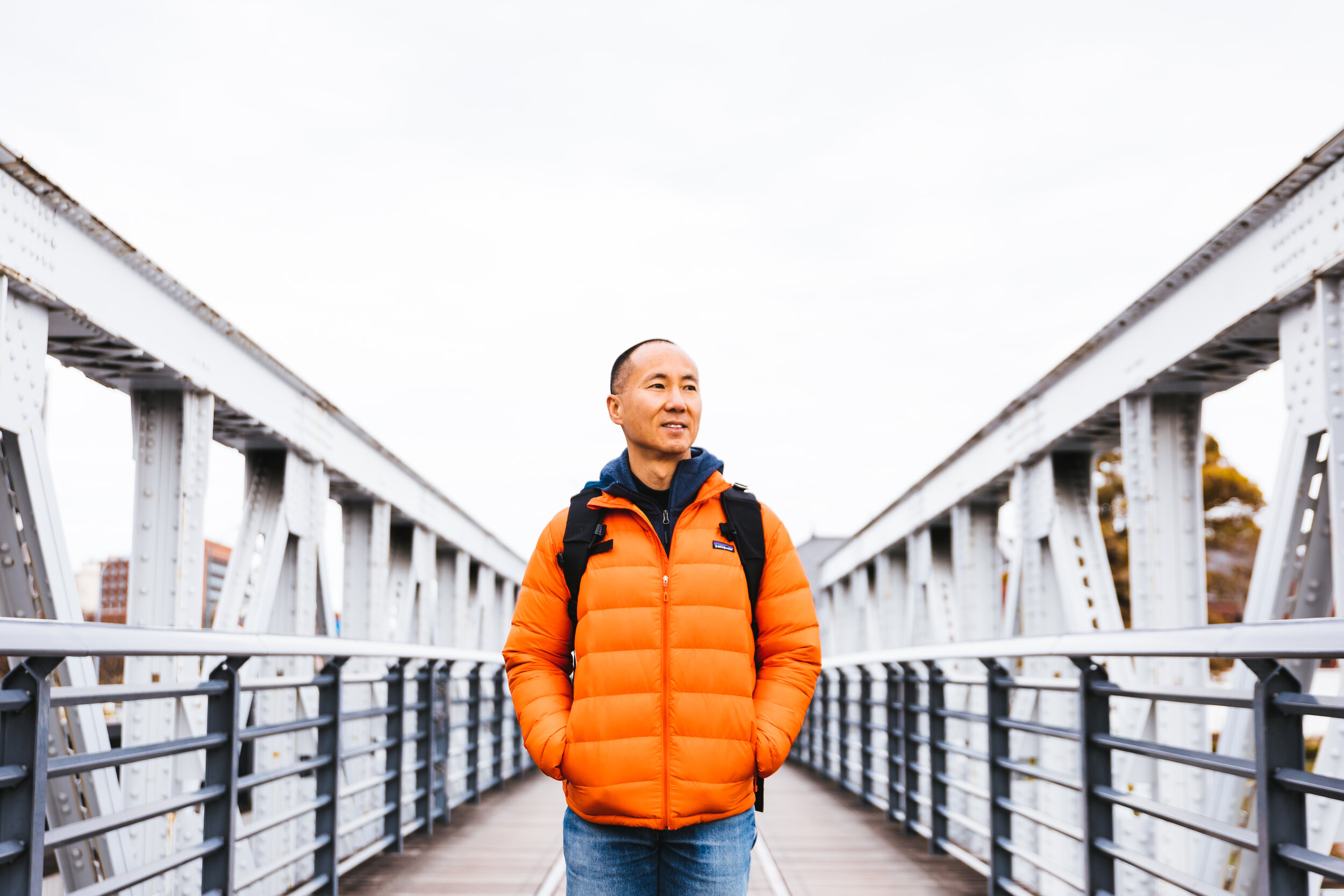
Tony-Wu-bridge

Tony Wu | Portraits for Lifehacker

August 17, 2020 in Editorial Photography
Tony-Wu-LifeHacker
Tony-Wu-LifeHacker
Tony-Wu-portrait
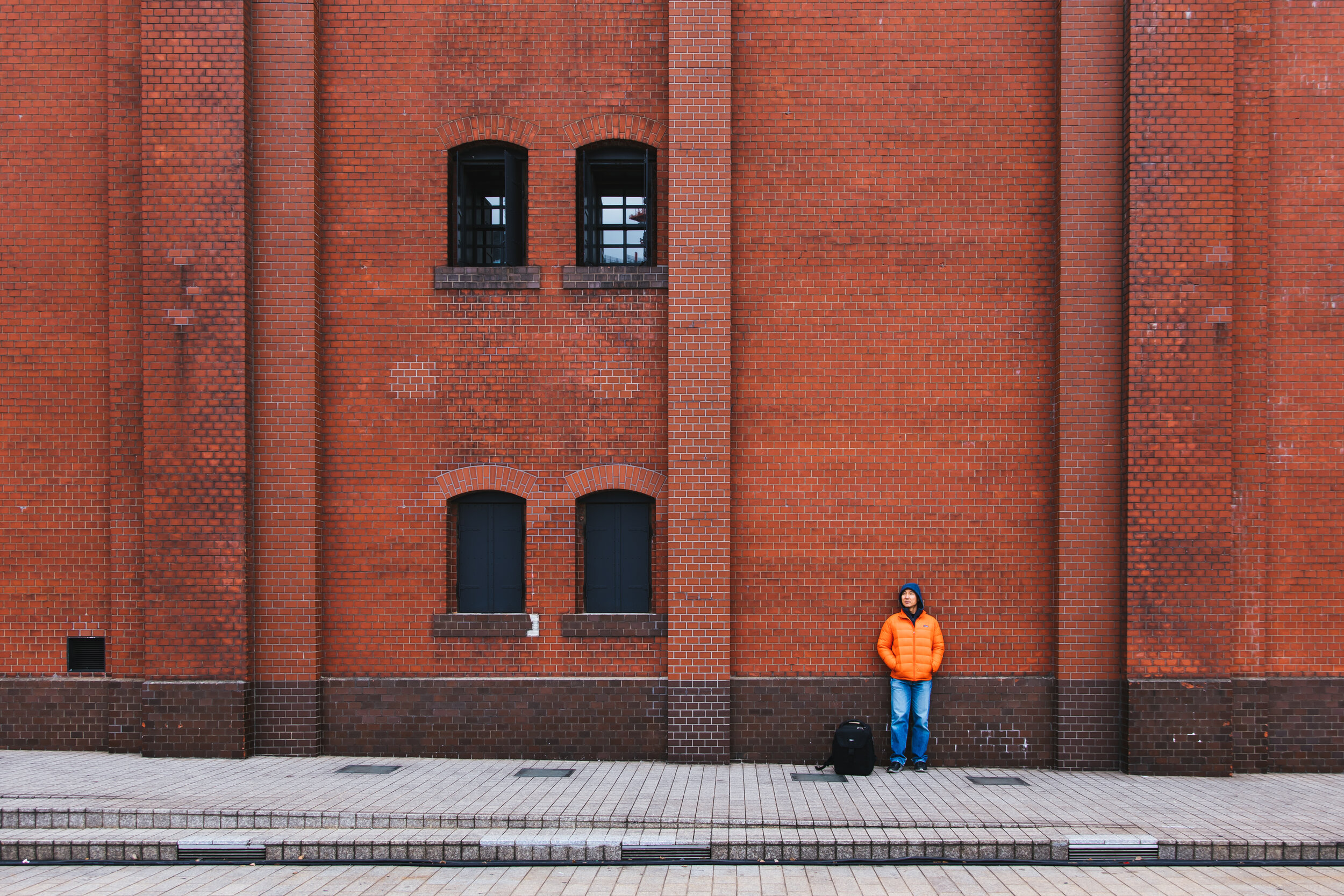
Tony-Wu-Yokohama
Tony-Wu-photoographer
Tony-Wu-crosswalk
Tags: Portrait
Comment
Motokoh Town - Kobe, Japan

Motokoh Town - Kobe, Japan

Japan Photo Journal #2

August 10, 2020 in Tokyo Photographer
Last of the Season - Niseko, Japan

Last of the Season - Niseko, Japan

Ferry - Miyajima, Japan

Ferry - Miyajima, Japan

When We Are Young - Osaka, Japan

When We Are Young - Osaka, Japan

Nunobiki Garden Hammocks - Kobe, Japan

Nunobiki Garden Hammocks - Kobe, Japan

Swan Boat - Nikko, Japan

Swan Boat - Nikko, Japan

Paused - Osaka, Japan

Paused - Osaka, Japan

Itsukushima Shrine - Miyajima, Japan

Itsukushima Shrine - Miyajima, Japan

Frost - Shirakawago, Japan

Frost - Shirakawago, Japan

Selfie Stick - Kyoto, Japan

Selfie Stick - Kyoto, Japan

Corridor Umbrella - Kobe, Japan

Corridor Umbrella - Kobe, Japan

Peace - Nara, Japan

Peace - Nara, Japan

Atomic Dome - Hiroshima, Japan

Atomic Dome - Hiroshima, Japan

Temple Calligraphy - Nikko, Japan

Temple Calligraphy - Nikko, Japan

Trees - Nara, Japan

Trees - Nara, Japan

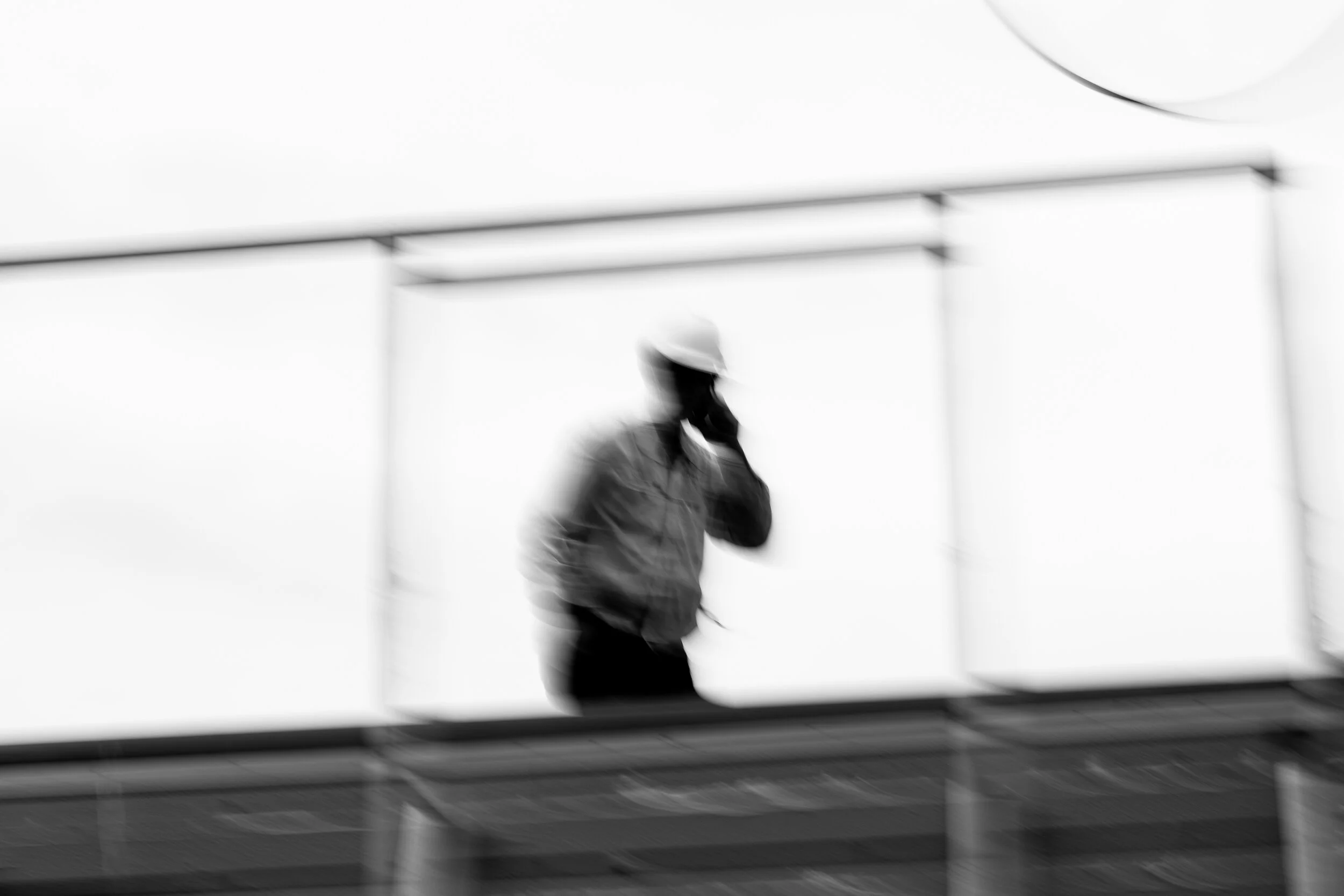
Construction Call - Osaka, Japan

Construction Call - Osaka, Japan

Ferris Wheel - Kobe, Japan

Ferris Wheel - Kobe, Japan

Gnarled Tree - Takayama, Japan

Gnarled Tree - Takayama, Japan

Nozomi View - Tokaido Line (Southbound)

Nozomi View - Tokaido Line (Southbound)

Wind Energy - Narita, Japan

Wind Energy - Narita, Japan

Sunset Watchers - Yokohama, Japan

Sunset Watchers - Yokohama, Japan

Rooftops & Sea - Kamakura, Japan

Rooftops & Sea - Kamakura, Japan

Fake Flowers - Shirakawago, Japan

Fake Flowers - Shirakawago, Japan

Dotonbori Corner - Osaka, Japan

Dotonbori Corner - Osaka, Japan


All images were made on and off assignment throughout Japan. For more images from the Land of the Rising Sun, check out my first installment of the Japan Photo Journal or explore the other links below.


Related Posts

Hiroshima, Japan - Today

Hiroshima, Japan - Today

Tokyo Photo Journal #3

Tokyo Photo Journal #3

Tokyo Photo Journal #4

Tokyo Photo Journal #4

Tags: Photo Journal, Japan, Journal
Comment
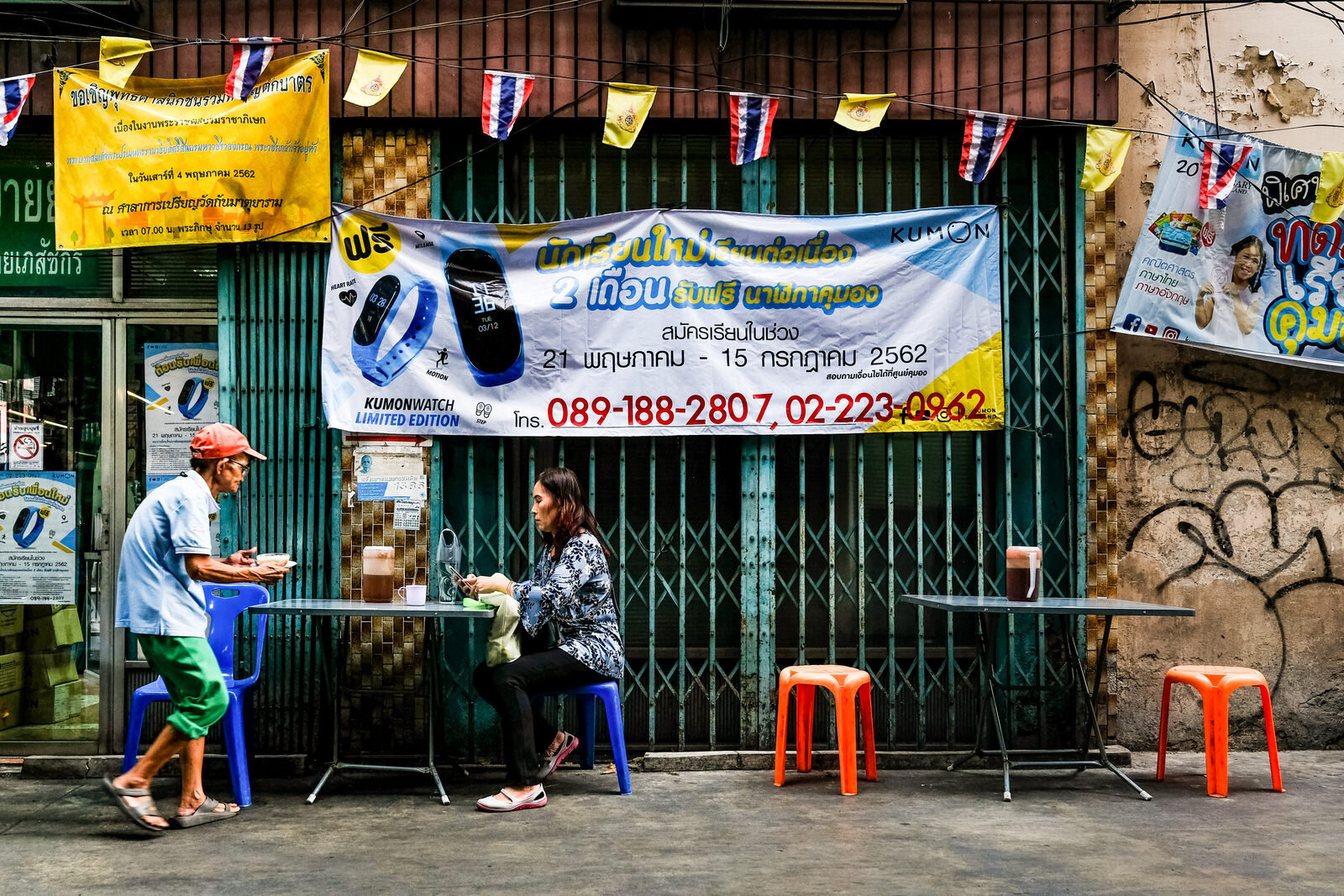
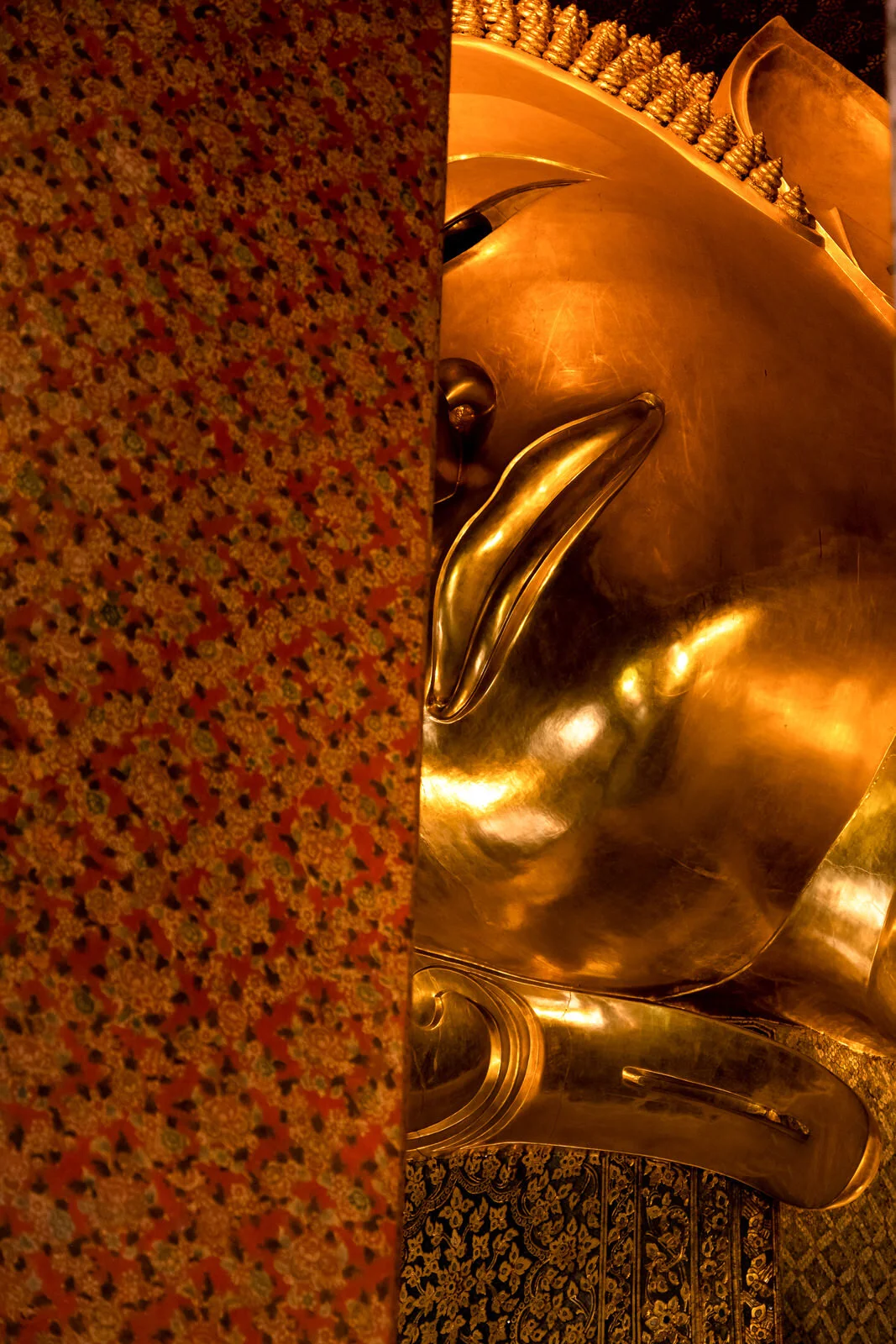
bangkok-abstract-buddha.jpg

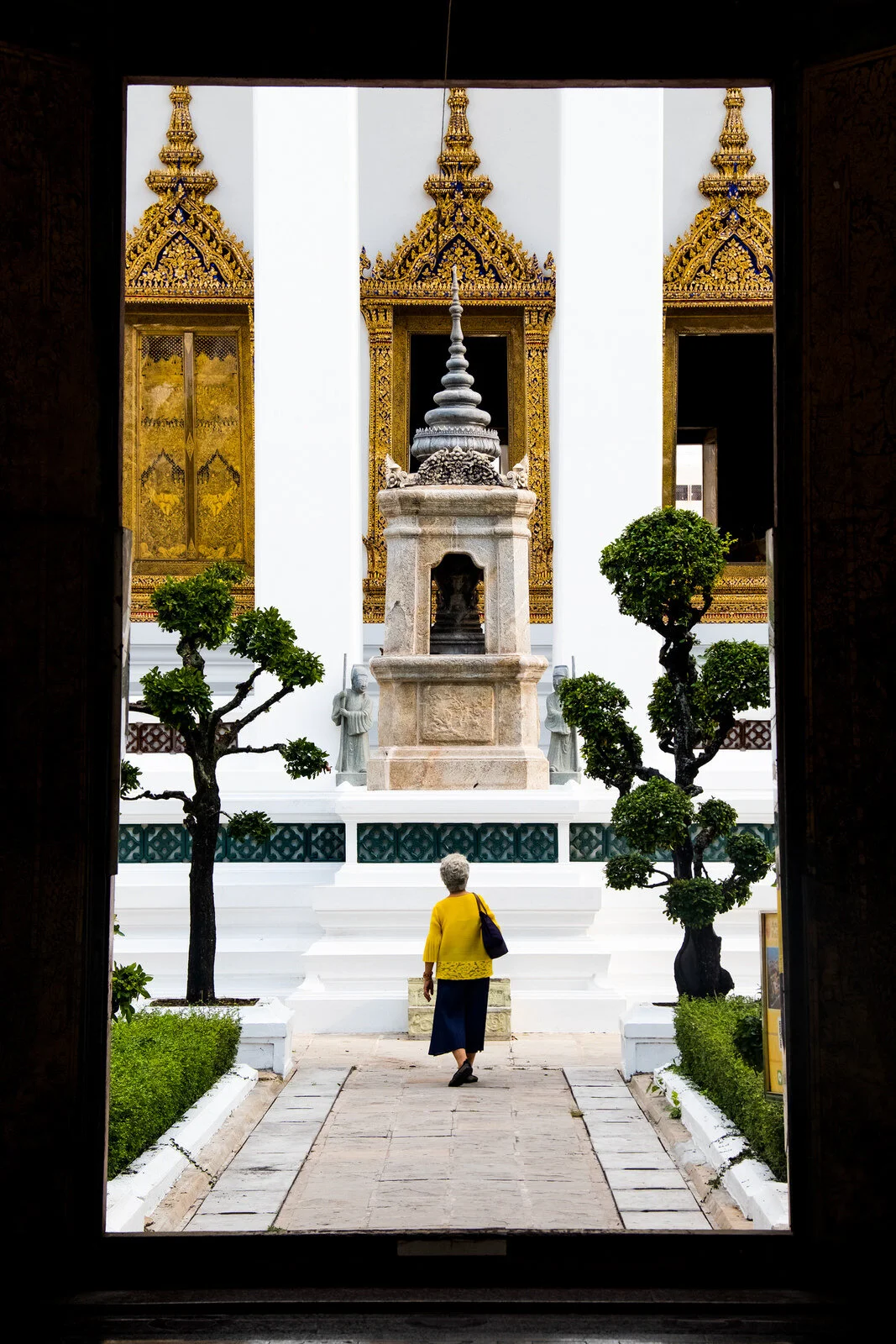
Bangkok Photo Journal #2

August 05, 2020 in Travel Photography
Bangkok-lunch.jpg
bangkok-motorbike-pan.jpg
Wat_Suthat_Bangkok-entrance.jpg
Emerald_Temple_Bangkok.jpg
Wat_Suthat_Bangkok-bnw.jpg
Grand_Palace_Bangkok.jpg
Bangkok-street-food.jpg
Thailan-BKK-temple.jpg
street-food-bkk.jpg
Wat_Pho_Prayer.jpg
Bangkok-Jek-Pui-Curry.jpg
Wat_Pho_Bangkok-family.jpg
Wat_Pho_Abstract.jpg
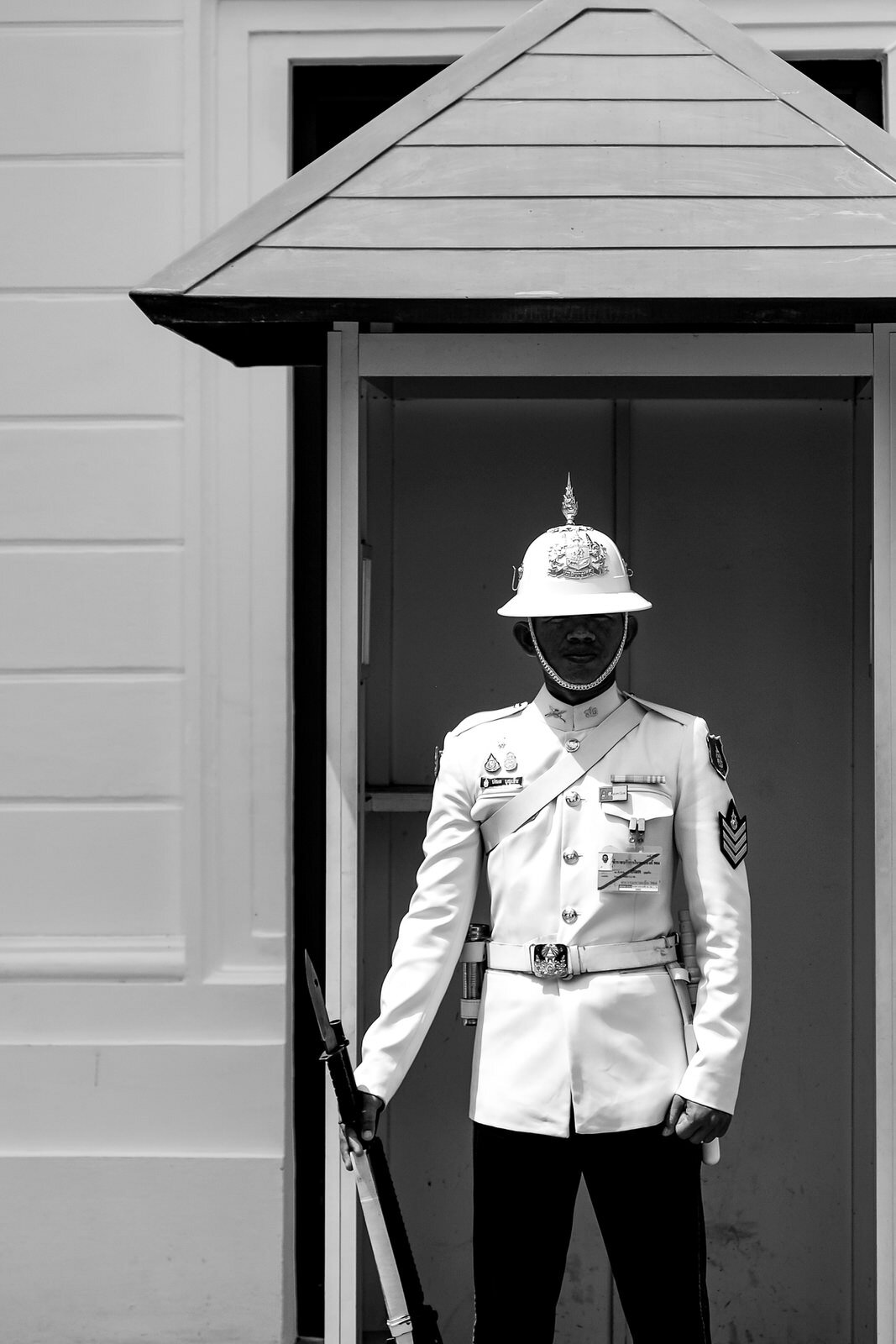
Bangkok-guard.jpg
Bangkok-street-scene.jpg

More Travel Photography

Kyoto Photo Journal #1

Kyoto Photo Journal #1

Bangkok Photo Journal #1

Bangkok Photo Journal #1

Travel Photography Portfolio

Travel Photography Portfolio

Tags: Photo Journal, Thailand, Bangkok
Comment
Prev / Next

Andrew Faulk

Andrew Faulk is a Tokyo-based editorial, travel, and commercial photographer working throughout Japan, Asia, and beyond. Drawn to the people who shape a place's character, his work explores the intersection of culture, travel, food, and hospitality. Andrew is available for editorial and commercial photography assignments worldwide. He is a father, husband, educator, heavy metal enthusiast, and makes the best mashed potatoes in the world.

No results found