



Today's Inspiration | Damari McBride
I met Damari McBride in a coffee shop in Seoul, South Korea. We were there, along with several other hobbyist photographers, for an off-camera flash course hosted by speed-lighting expert Dylan Goldby. I ordered a latte, plopped down in an empty seat next Damari, and began chatting away as if we were old friends picking up a conversation where we had last left it.
While that initial chat was over seven years ago, I distinctly remember how affable Damari was. With an infectious laugh and a cheeky smile, Damari had a particular magnetism. It was obvious that he had a great sense of humor and a friendly demeanor. But, I could also tell that McBride had many more layers under his jovial façade. There was an artist’s sadness about him and I imagined what he was like when he was alone, without the presence of others and social conventions in place.
Soon after, Damari returned to the United States and I moved to Japan to launch my portraiture business in Tokyo. Ever since we have kept in touch and continue to act as a support system for one another.
It has been an honor to watch his photography career develop and to witness his artistic journey. From analog portraiture in the streets of New York to his stunning work with Photographers Without Borders in South Africa, from his residency at Atlantic Center for the Arts to his musings in mixed media, I am always interested to see what is next for McBride. He is a leaf in a river and I remain constantly curious to know where he will wash out of the rapids.
I wanted to know more about the ebbs and flows in the evolution of McBride as a photographer and he was kind enough to sit down with me to answer some of the questions I have always had about his craft that, until now, I have just never asked.

DAMARI MCBRIDE
If you had one minute to give a complete stranger a synopsis of who you are, what would you say?
I’m a portrait photographer currently based in New York City. I’m a married man and have a corgi named Peach Queen Latifah Holt Alexander McBride (who I paid ten extra dollars to have her registered because of the length of her name).
I love traveling.
My biggest passion outside of photography is cooking and baking. I don’t want to toot my own horn, but I’m pretty good at it (unless is it curry, I’m still struggling with that damn curry).
My favorite subject to photograph is people, any person, any human. I am interested in humanity and the societal conditions we individually and collectively endure. We always speak to our differences and what makes us unique rather than what connects us. While being different is something that should be appreciated and discussed, I find that there is much more that connects us than separates us.
I like the human aspects of life and create work that explores that human connection.
You grew up in Michigan. Tell me a bit about that experience and your formative years.
I grew up in Grand Rapids. As a kid, I was always daydreaming and creating. I built clubhouses and mixed “magic potions” to protect them by mixing different cleaning supplies together. I tried my hand at BMX riding but failed. You know, crazy kid shit. I honestly don’t know how I’m alive.
I was a creative kid and always needed to be moving. I need to touch and experiment with things. I doodled. I got into music. I messed around with anything that kept my imagination running wild.
Do you feel that those formative years influenced you as a photographer?
Yeah, I do think that my youth had an influence on me as a photographer. I still daydream and create with a ten-year-old perspective. I’m always wondering “what-if.” My childlike wonderment hasn’t gone anywhere and I don’t ever want it to.
How did you get to this point in your journey as a photographer?
I played around with the idea of myself as a photographer for the longest time. I questioned whether or not a career in photography was something I wanted to actually pursue. I had a lot of self-doubts.
I think the biggest milestone was making the decision to move to NYC and actually go for it, become a professional photographer. That was a tough decision, to move to such a competitive market. But, I did it and that leap of faith paid off.
Since moving to NYC, I have been able to shoot on film sets, expand into videography, and meet other creatives who continue to inspire me. The reward was worth the risk.
Why do you pick up the camera? What is it about the medium that resonates with you?
I have ADHD to the max, shit is real. My mind moves at such a fast speed it is, at times, hard to control. Photography helps me interact with the world at a calmer, more sustainable pace.
Photography is also a tool I use to help me communicate. Sometimes I find it difficult to put my thoughts into the written or spoken word. Photography, in a way, became my language. Through my camera, the world looks clear to me. Because of the slower pace that my style of photographing demands, I am forced to slow down, to see instead of look.
What have been some failures you have experienced as a photographer thus far? How have you reacted in relation to those failures?
I think my biggest failures have come from constantly beating myself up. Comparing myself to other creatives pushed me into stagnation, a place of little creation, inspiration, or motivation. It didn’t help when rejection letters and emails came in after submitting the work I actually managed to produce during that dark time. Between my inability to accept rejection and my own self-doubts, I was my own worst enemy.
I don’t really think you ever get over the rejection that comes your way, or at least I haven’t. I have, however, changed the way that I absorb rejection. A good friend of mine told me, “There is always someone that’s going to be better than you smarter than you, more creative than you. But don’t let them out-work you.” That advice is a constant reminder that I need to work harder. I need to put more work out.
Now, for every “no” that I get in my inbox, I just create another body of work that’s important to me and put it out into the world with my middle finger in the air. I now view the “failures” as opportunities for progress instead of catalysts for stagnation and self-deprecation.

PHOTOGRAPHERS WITHOUT BORDERS
A couple of years ago, you had a stint in South Africa with Photographers Without Borders (PWB). Can you tell me a bit about how that collaboration came about?
At the time, I had just become a freelancer. Anyone who is a freelancer knows that you have to invest in yourself before anything else. After years of living abroad, I felt an itch… I needed to leave New York. I wanted to travel, to go overseas without breaking the bank. I also didn’t want to compete with the never-ending line of photographers scrapping to land that glorious travel or documentary assignment.
Thankfully, Lord Google led me to Photographers Without Borders. I worked up the courage to apply and was quickly accepted. PWB used my portfolio to gauge my ability set and matched me with a project that would be a good fit for my visual style and for their organization. A couple of weeks after receiving the great news that I was onboard with PWB, I received my final assignment.
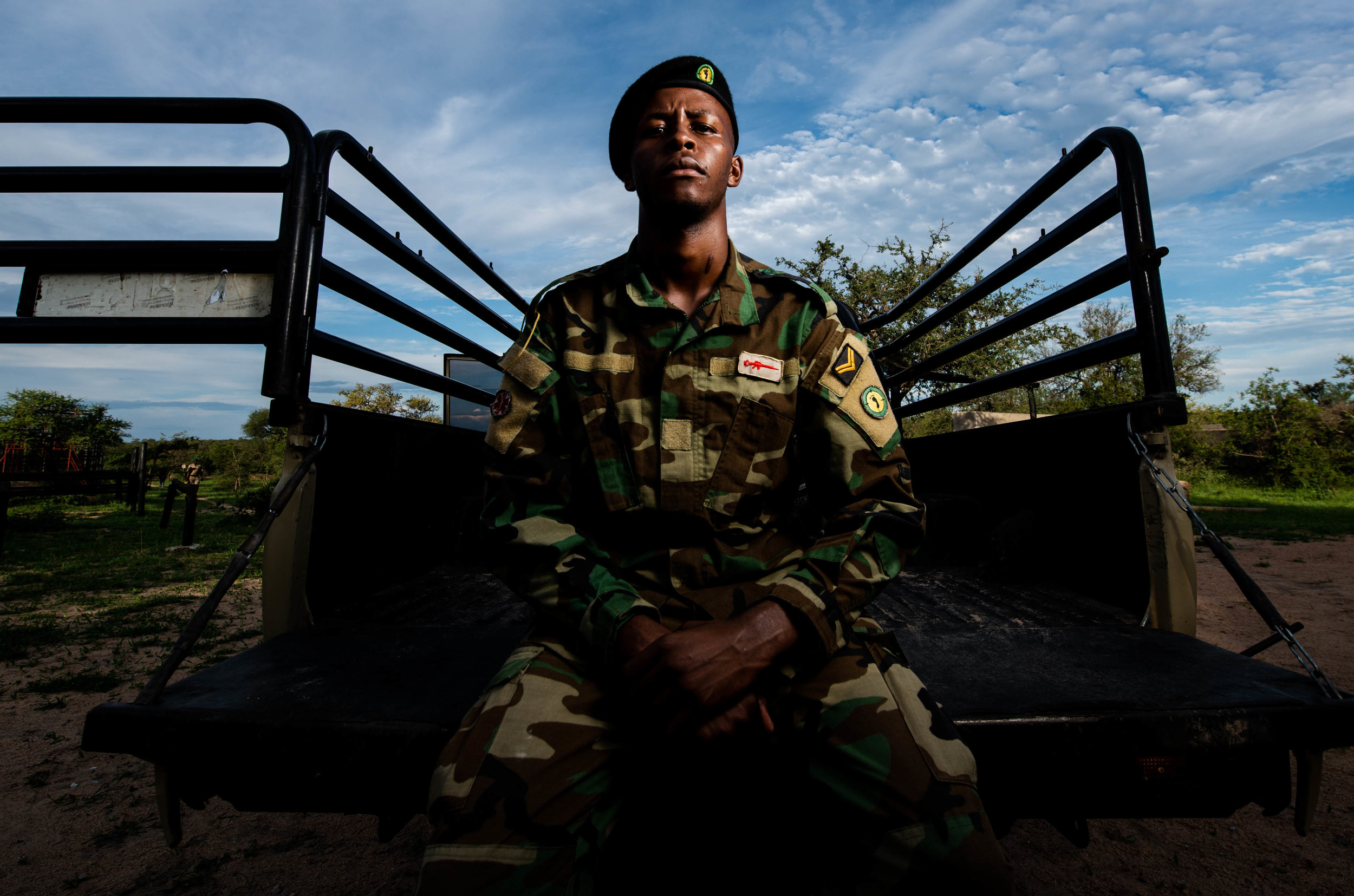
I was sent to South Africa to cover a story about poaching in the Hoedspruit region, a five-hour drive northeast of Johannesburg. You might know of the region because it is where Kruger National Park is located. Hoedspruit happens to be adjacent to one of Africa’s largest game reserves, a wildlife conversation area where poaching is a multifaceted problem due to the economic disparities in South Africa.
Before I knew it, I was in the thick of one of the most powerful experiences of my life.
What were some of your initial reactions when arriving in Africa?
Elders. Old grannies. Black people, who look like me, were everywhere.
There was wildlife, actually in the wild instead of a zoo’s cage.
I noticed kids who looked healthy, not like the ones portrayed in the Donate-A-Dollar to Africa commercials you see at 4:00 a.m. on television.
I saw life.
I felt like I was home.
My first impressions also allowed me to see that poverty can wear one hell of a mask. Poverty exists everywhere, it just looks a little different from place to place. The struggles that families in South Africa face reminded me that we have a collective struggle, it just appears a bit differently. I was reminded that someone, or some group of people, always gets the short stick. Those unlucky enough to draw the tiny straws have to hustle… struggle. They have to provide and often have to resort to the unthinkable because they are deprived of the basic needs and necessities to survive.


Even though you were working with a pair of NGOs, the work you created in South Africa resonates like a personal project full of striking portrait subjects. After your work with PWB, do you feel that your time acted as a catalyst for a larger body of work or for a future personal project?
I do feel like my experience was a catalyst for a larger body of work. The PWB project prepared me for documentary and social project commissions that I would love to pursue. My work with PWB was my first assignment of this nature. I didn’t know what to expect.
Now, after the experience, I have a larger picture of what it takes to approach these types of projects with not only my visual style but with a deeper appreciation and understanding of the human condition. I think that this mentality translates into some of the portraits that I made in South Africa and encourages me to continue to pursue this type of work.

ATLANTIC CENTER FOR THE ARTS
After returning from Africa, what came next?
Just before leaving for Africa, I accepted a teaching position at a non-profit. Stepping off the plane in America, I knew that I had to return to work the very next day. I didn’t have time to process the experience I had just had.
I was upset that I didn’t have the time or space to process my emotions. The PWB assignment made me want to move further away from a life as a full-time professional to one of a more balanced freelancer, a position that would not only allow for creativity but for the time it affords artists to be reflective. So, I quit.
Shortly after exiting the rat race, you applied for and received an invitation for a residency at the Atlantic Center for the Arts. What you set out to accomplish during your time at the ACA?
What type of artist am I? That was the central question I set out to answer for myself. I wanted to discover and define who I am as an artist. At the ACA, I had the time to contemplate that question. More, I was surrounded by like-minded creatives from diverse backgrounds that challenged me to dig deeper in my quest to answer that central question.
During the residency, I discovered just how much I love people and the stories and experiences that define them.
As a photographer, I love to capture vulnerability, which is one of the greatest strengths one can display. Being vulnerable shows humility, strength, courage, and our human nature at its core. When we give in and let our guards down, we have the ability to connect with others without saying anything at all. My work at the ACA shows the beauty of vulnerability and the discovery of the type of photographer I desire to be. I want to challenge the way we, as society view vulnerability as something to be hidden instead of shown. I want to become more vulnerable and have the ability to freely share my own mistakes, shortcomings, thoughts, misgivings, fears, and heartbreaks without the fear of judgement, without being labeled.
My time at the ACA was exactly what I needed. For years, I had created quality work but told myself I wasn’t good enough. I searched everywhere for validation, everywhere but within myself. There, at the ACA, I found that validation and was left with no more excuses. I was empowered. I found an answer to the question I came to the ACA to discover. The experience was transformative and led me to who I am currently am as a photographer.


What did you learn about yourself from your residency at the ACA?
I learned that I am good at what I do. I have a strange way of connecting with subjects when I take my time and create images that tell their story just by looking at their portrait. I learned that slow and steady does win the race. I learned that is okay to take your time to make a good photograph. I learned that I am still my own biggest enemy.
The change, though, is now I notice when I am being self-defeating and I actively fight those inner voices instead of feeding into the lies that I spew to myself. I accept that there are better photographers than me. I accept that I am just at the beginning of my journey as an artist. But I now also accept that I do have something special to offer… and nobody is gonna outwork me.
See more of Damari McBride’s work at his website and be sure to follow him on Instagram.
Related Content



Somewhere Above Ethiopia
I have a fear of flying and will do almost anything to make air transit emotionally bearable. I pack an extra shirt in my carry-on just in case I nervously sweat through the one on my back. I have plenty of peaceful music downloaded on my phone. I keep a special amulet or two in my pocket even though I am not religious or superstitious. I also hold a stash of “airplane candy” just in case. Short of having a service animal registered, I do all that I can to soothe my fears.
After boarding, I try not to look at other passengers, be over-stimulated by the romcoms playing on screens, or get too fixated on my pre-determined escape plan should the aircraft take a plunge (I honestly make an overly detailed action plan before each flight takes off. It’s ridiculous).
My greatest flight comfort is a window seat. If possible, I pay the additional fee to pre-select my seat or, at the very least, beg for one at the check-in counter. I prefer to be near a wing where, in my phobic-mind, the plane is most stable and where an exit row is usually nearby. Oddly, window seats make me feel less claustrophobic and I covet the tiny area of space between my seat and the convex edge of the plane. Those extra square inches make me feel that I have some sort of protective bubble around me.
Without a doubt, the best part about a window seat is the chance to view the landscapes far below, gaze at giant cumulonimbus clouds, or peer at stars that seem so much closer from 32,000 feet. The natural world, an arms-length away, is my soothing, constant in-flight entertainment.
After a ten-hour red-eye flight from Bangkok and a quick layover in Addis Ababa, I was glad to finally be on a domestic flight heading north towards Lalibela. The sun was up I could have my first real glimpse of Ethiopia.
From cruising altitude, it wasn’t possible to get any sort of perspective of Ethiopian culture (other than noticing the agrarian nature of the countryside). But that didn’t matter. I was able to recognize, at least from above, that I was already in love with Ethiopia.
For the duration of the short flight, I didn’t have any fear of flying. I didn’t sweat through my shirt or pull out the prayer beads from my pocket. Instead, I sat in awe of the expansive landscape and was again grateful for a window seat.


More Travel Photography


Hids’ Cafe & Bar | Food Photographer
Takayama, Japan
Japanese restaurants are abundant in Takayama. Because of this, Hids’ Cafe and Bar (HCB) is a culinary oasis. For those who have had their fill of local cuisine, HCB is a godsend. But with offerings like succulent grilled chicken (served with blackened corn and zucchini), classically battered fish & chips, and juicy steak platters, it will be hard for anyone to pass on HCB’s menu.
HCB also serves as a bar. From Hida beer to a signature ninja cocktail, fresh kiwi-shochu concoctions to perfectly crafted espresso drinks, HCB has a slew of beverage options to quench any thirst.
The cafe’s interior is tasteful and the atmosphere is inviting. Simply put, HCB is one of those places where you pop in for a quick bite of lunch and end up leaving two or three hours later.


The Problem
With so many F&B options around Takayama’s tourist district, HCB wanted to ensure that customers didn’t just stop to have a peek inside. They wanted clientele to swing open the doors, grab a table, and indulge in the carefully crafted menu.
HCB realized that customers don’t choose a restaurant solely based on location. Consumers want atmospheric interiors. We want to dine at restaurants with five-star reviews. We want visuals of our meal options. For some reason, we feel a need to see a dish before we order it. When it comes to food, visuals make us salivate.
HBC had it all; a modern menu, stellar staff, and inviting space. All Hids’ lacked was the imagery that would entice entrée orders.
The Solution
HCB decided to commission a full run of their food and beverage offerings for both print and digital platforms. After meeting with management, we decided to correlate the project visuals to the defining characteristics of the location. Additionally, we settled on a few guiding words that would move us towards a mood for the imagery.
Simple. Open. Sleek. Chic.
I decided to utilize large amounts of negative space, clean compositions, and some of the colors that reminded me of Takayama (greens and bright browns found in the cedar forests of the surrounding mountains and the grays of the cobblestone streets leading from HCB’s doorstep to Takayama Station nearby).
I also decided to strip the compositions of the accouterments commonly seen in modern food photography. I didn’t want flatware, massive sprigs of garnish, or dashes of spice strewn all over the place. I wanted the focus to be on nothing but the amazing food and beverages made at HCB.
The Result
The images produced during my time in Takayama are not only being used in-house by HCB but are also being utilized on TripAdvisor and other social media channels. Hids’ is already being recognized as one of the best cafes in Takayama and links to HCB are popping up on a number of tourism websites. Since launching its F&B visuals campaign, HCB has reported an increase in customer volume and overall revenue.


Is your business in need of new imagery? If so, get in touch today to discuss your commercial food photography project in Tokyo, throughout Japan, or beyond.

Bartender at Godz, a basement bar in Shinjuku that blasts heavy metal.
Shinjuku Hotspots for American Way Magazine
Over the past couple of years, travel editorial assignments have taken me far and wide. My occupation as a fulltime photographer is the stuff daydreams are made of. I admit the job has its perks. I get to see a bit of the world, learn about different cultures, and enjoy making images for a living. Professionally, I couldn’t ask for more.
But one of the drawbacks of being a professional travel photographer is the time away from home. It doesn’t matter how long an assignment is. It doesn’t matter if the job takes a few days or a couple of weeks. Time away from home takes a toll. As a general statement, I don’t like being away from my family, my comfort zone, and my own pillow. Don’t get me wrong… I love travel assignments. But, I don’t love being away from my wife and son.
Last October I received a commission from my good friends at American Way, American Airlines’ inflight magazine. After a few months with a hefty travel schedule, I was happy to learn that the assignment was here in Tokyo, photographing some of Shinjuku’s lesser know spots. Shinjuku is, perhaps, Tokyo’s most famous neighborhood. Still, there are many haunts that are overlooked, unknown to the throngs of tourists who come to Tokyo.
While I rarely visit the district, I admit that Shinjuku is a great place to photograph. The gritty alleys, seedy nightlife, and the world’s busiest commuter hub (Shinjuku Station) can make for photo-gold. The neighborhood also happens to be right down the tracks from my home in nearby Kichijoji. Considering this, I was happy to work on the piece and was just as thrilled to be home in time to kiss my wife and son goodnight.
Check out a couple of images from the assignment and, if you are interested, read more about these Shinjuku hotspots in the Neighborhood Watch section of American Way.

Preparing gyoza at Danji Dumplings.

Gyoza ready to fry at Danji Dumplings.

Chef at Ouka Ramen.

Danji Dumplings exterior.

Tokyo’s best halel ramen at Ouka Ramen.

Kuriya’s aging menu, posted for review in Kabukicho.

Piping hot stew on offer at Rakudaba.